


Anchora Capital AS Review
Anchora Capital AS presents itself as an international online broker offering access to multiple financial markets. The website promotes trading in currencies, cryptocurrencies, stocks and other instruments, while also displaying references to major financial institutions and regulators.
At first glance, anchoraas is designed to look like an established financial company. It uses a professional corporate identity, presents different account levels and emphasizes regulation, international market access and financial technology.
However, a proper broker investigation begins somewhere else.

The first question is not how professional the website looks. It is who legally operates the platform, what license that entity actually holds, which domain belongs to that entity, and whether the services offered to retail clients are covered by that authorization.
Those checks raise serious concerns about Anchoraas.
The most important issue is particularly unusual: there is a genuine Norwegian company called ANCHORA CAPITAL AS, but its official public profile does not match the retail brokerage business presented at anchoraas.
A Real Company Exists – But That Does Not Validate Anchoraas
ANCHORA CAPITAL AS is a genuine Norwegian legal entity. The Brønnøysund Register Centre lists the company under organization number 929 170 407, with a registered address at Parkveien 57, 0256 Oslo. Its registered industry code is 64.312, covering other investment companies.
This is an important distinction.
The existence of a company with the same name does not automatically prove that a website using that name belongs to the company.
In fact, the official website of the Norwegian Anchora Capital tells a very different story from the retail brokerage operation presented by anchoraas.
According to the company’s own website, Anchora Capital AS is an alternative investment fund managed by Anchora Management AS. The fund is registered with the Financial Supervisory Authority of Norway and is intended for professional Norwegian investors. Its stated investment objective is focused on listed small-cap technology companies in the Nordic region.
That is not the same business model as a mass-market online broker offering trading accounts to retail customers.
The Official Website Is Anchora.capital
The distinction becomes even more important when the company’s official web presence is examined.
The official Anchora Capital website is located at anchora.capital. The company’s own website identifies Anchora Capital AS as the fund and Anchora Management AS as its manager.
The LEI record for ANCHORA CAPITAL AS also lists www.anchora.capital as the entity’s website. The LEI record identifies the legal entity as ANCHORA CAPITAL AS, organization ID 929170407, jurisdiction Norway, and entity category FUND.
The retail trading platform under investigation, however, operates through anchoraas.
This distinction matters.
Using the same corporate name is not enough to establish that two websites are operated by the same legal entity. A legitimate broker should be able to provide a clear and verifiable chain connecting its trading domain, legal entity, license and customer agreement.
That connection is precisely what needs to be established before anyone deposits money.
The LEI Does Not Prove That Anchoraas Is a Licensed Broker
Anchoraas uses the LEI associated with ANCHORA CAPITAL AS.
The LEI itself is genuine. The problem is what this fact actually proves.
An LEI identifies a legal entity. It does not automatically grant authorization to provide brokerage services, accept retail deposits or offer leveraged trading.
The official LEI record identifies ANCHORA CAPITAL AS as a Norwegian fund and gives its official website as anchora.capital. It does not establish that anchoraas is an authorized retail brokerage platform operated by that entity.
This is a critical distinction that prospective clients should understand.
A scam website can potentially use the details of a real company to create an appearance of legitimacy. Therefore, finding a real LEI is not the end of a broker verification process.
The real question is:
Does the legal entity behind the trading platform actually own and operate the domain and hold the necessary authorization for the services being offered?
That question remains unresolved for anchoraas.
The Regulatory Claims Require Independent Verification
Anchoraas reportedly presents itself as regulated by major financial authorities and refers to organizations including CySEC and the CFTC, as well as FINRA, SIPC and NYSE.
These are serious claims.
A broker cannot establish regulatory status simply by placing a regulator’s name or logo on its website.
The legal entity providing the financial service must be identifiable in the relevant regulator’s official database, and its authorization must cover the services being offered.

The CFTC itself explicitly advises consumers to verify the registration and regulatory history of a firm before trading commodities, futures, options, forex or other derivatives. The agency directs users to the NFA BASIC database for this purpose and warns that most scams involve unregistered entities, individuals or products.
This is exactly the standard that should be applied to Anchoraas.
A statement such as “regulated by CFTC” is not evidence by itself.
The required evidence would be a matching legal entity, a verifiable registration and authorization, and a clear connection between that entity and the actual trading platform.
The Business Model Does Not Match the Real Norwegian Fund
This is one of the strongest red flags in the entire investigation.
The legitimate Norwegian Anchora Capital describes itself as an alternative investment fund for professional Norwegian investors. Its stated investment strategy focuses on Nordic small-cap technology companies.
Anchoraas, on the other hand, presents a retail-oriented trading operation.
The website promotes trading accounts, leveraged trading and access to multiple financial markets.
These are fundamentally different business models.
That does not automatically prove that the two entities have no relationship. A company can operate several businesses.
But if that were the case, the relationship should be transparent.
There should be a clear corporate statement explaining that anchoraas is an official service of ANCHORA CAPITAL AS, together with the relevant authorization and legal documentation.
Without that evidence, the existence of the Norwegian fund cannot legitimately be used as proof that the retail trading website is trustworthy.
The Domain History Is Another Major Warning Sign
The anchoraas domain was registered on August 20, 2026, according to current public domain information.
That is a very recent date for a website presenting itself as an established international financial operation.
A new domain does not automatically mean that a company is fraudulent. Legitimate companies launch new websites every day.
The problem arises when a newly registered domain is combined with claims suggesting a much longer corporate history, substantial market presence and extensive financial infrastructure.
In that situation, the operator should be able to demonstrate the historical connection between its current website and its alleged previous operations.
A long corporate history should leave evidence: previous websites, archived pages, regulatory records, corporate documents, media coverage and other independent references.
The current public footprint of anchoraas does not provide enough evidence to establish such a history.
The 2008 Bitcoin Claim Raises an Immediate Chronology Problem
Another particularly striking claim associated with the platform is a reference to Bitcoin trading since 2008.
That statement deserves scrutiny because the Bitcoin network was launched in January 2009.
Therefore, a claim of trading Bitcoin in 2008 cannot simply be accepted at face value.
There may be an innocent explanation, such as a wording error or a reference to a different activity. But a financial company making historical claims about its experience should be able to explain such a contradiction clearly.
This matters because the platform is attempting to establish credibility through its alleged history.
If the historical claims cannot withstand basic chronological verification, they should not be treated as evidence of experience.
Why References to Major Financial Companies Matter
Anchoraas also uses financial-industry language and material associated with major established institutions.
This includes references to Interactive Brokers technology and financial figures that appear designed to convey the impression of substantial institutional infrastructure.
Again, the important question is not whether Interactive Brokers is a legitimate company.
It is.
The question is whether Anchoraas has a verifiable contractual or corporate relationship with Interactive Brokers and whether customers of anchoraas actually receive services through Interactive Brokers.
A website mentioning a major financial company does not establish such a relationship.
If Interactive Brokers is genuinely involved, the relationship should be documented in the customer agreement and other official materials. The client should be able to identify who holds the account, who executes transactions, who holds the assets and which entity is legally responsible.
Without that documentation, references to a well-known financial institution can simply create an impression of credibility.
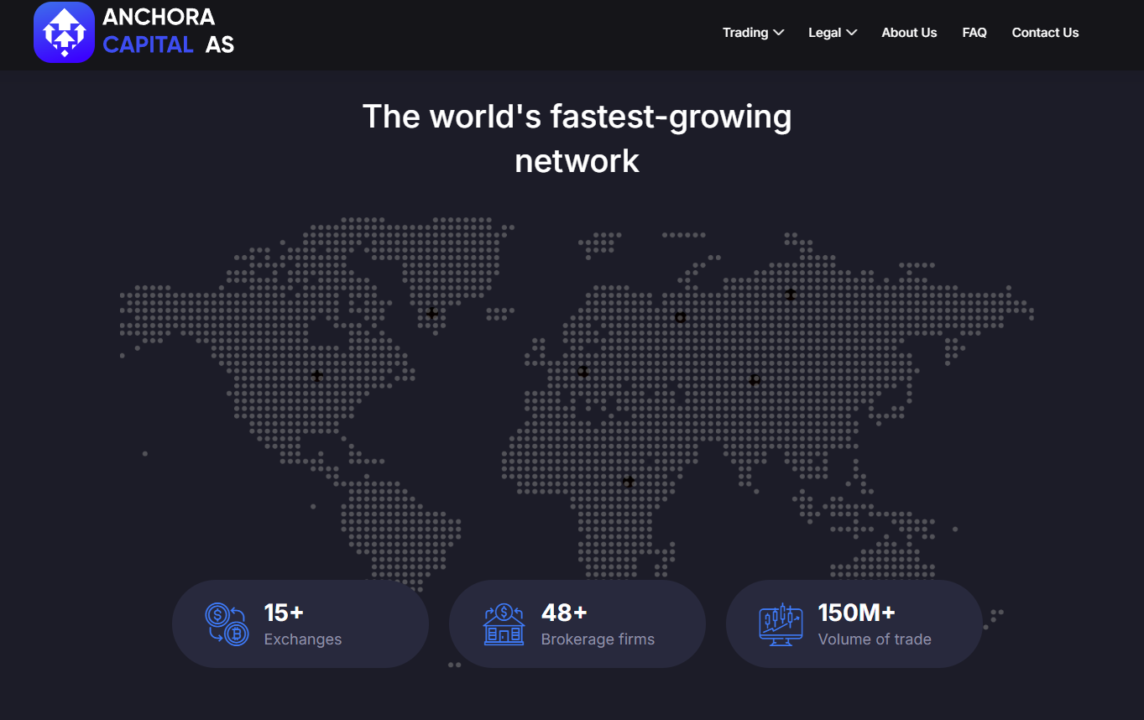
Impressive Numbers Are Not Proof of a Brokerage Business
Financial websites frequently use large numbers to establish authority.
Trading volume, number of clients, number of exchanges, institutional capital and the number of brokerage partners can all make a company appear substantially larger than it actually is.
But numbers displayed on a marketing website are not independent evidence.

For a serious financial institution, important figures should be supported by financial statements, regulatory disclosures, audited reports or other verifiable documentation.
This is especially important when a very young domain claims to represent a large and established international business.
The more extraordinary the claim, the more important independent verification becomes.
What About the Trading Accounts?
Anchoraas promotes different account levels and trading conditions, including relatively accessible minimum deposits and leveraged trading.
This is precisely where potential clients should stop looking at the advertised benefits and start reading the legal documentation.
The important questions are not:
“How tight are the spreads?”
“How large is the bonus?”
“How high is the leverage?”
The important questions are:
Who is the contractual counterparty?
Where is the company incorporated?
Which regulator authorizes it?
Where are customer funds held?
Who executes the trades?
What happens to client money if the company becomes insolvent?
Which legal entity processes withdrawals?
Which jurisdiction governs disputes?
These questions determine whether a broker is actually accountable to its customers.
Bonuses Should Be Treated With Particular Caution
Bonus-based trading offers can create an additional problem.
A bonus may come with turnover requirements, minimum trading volumes or other restrictions that can make withdrawing funds more complicated.
The headline figure is therefore not what matters.
The important part is the withdrawal clause.
Before accepting any promotional credit, a customer should know whether the bonus can restrict withdrawals of their own deposited capital, whether the customer must reach a certain trading volume, and whether the company can change or cancel the bonus conditions.
If these conditions are unclear, the bonus should not be considered a benefit.
It may instead become another mechanism for keeping the customer’s funds inside the platform.
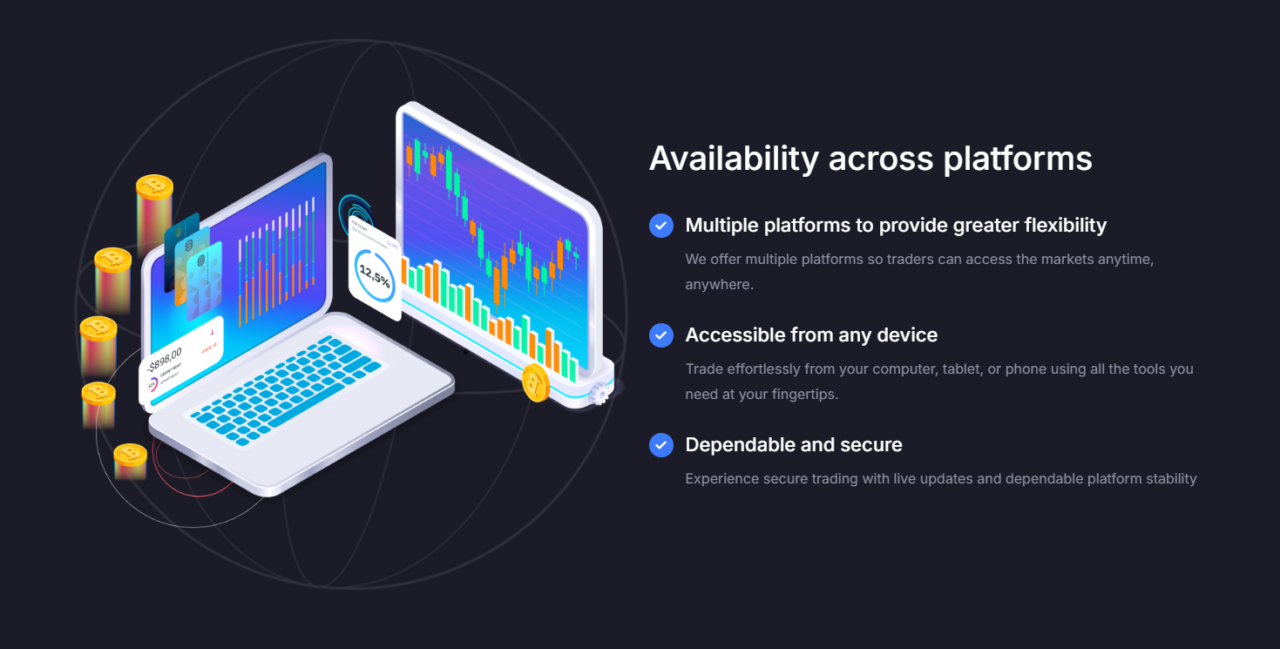
A Trading Dashboard Is Not Proof of Real Trading
Another common misconception is that a professional-looking trading terminal proves that a broker is legitimate.
It does not.
A website can display:
- account balances;
- open positions;
- profit figures;
- charts;
- transaction histories;
- market prices.
None of those elements independently proves that the corresponding transactions exist at a real exchange or liquidity provider.
The only meaningful verification comes from the underlying financial infrastructure and the legal entity responsible for the account.
This is why broker verification must happen before a deposit rather than after a withdrawal problem.
The Identity Problem Is More Important Than the Website Design
When all available information is considered together, the central issue becomes clear.
There is a genuine Norwegian company called ANCHORA CAPITAL AS.
It is registered under organization number 929170407.
Its official website is anchora.capital.
Its LEI is 254900PH979J802A2B70, and the LEI record classifies it as a fund and identifies anchora.capital as its website.
The company’s own website describes an alternative investment fund intended for professional Norwegian investors.
Separately, anchoraas presents a retail trading platform.
That difference cannot simply be ignored.
The existence of the real Norwegian company does not validate the retail website.
If anything, the use of the same corporate identity makes verification even more important.
The Red Flags Are Not Isolated
Anchoraas should not be evaluated on one suspicious detail alone.
The concern comes from the combination of several issues:
The website operates under a recently registered domain.
It uses the name of a genuine Norwegian investment company.
It references the genuine company’s LEI.
The official LEI record identifies a different domain – anchora.capital.
The legitimate Norwegian company describes itself as an alternative investment fund for professional Norwegian investors rather than as a retail trading platform.
The website makes broad claims concerning major regulators and financial institutions that require independent verification.
Its business model appears materially different from the business described by the real Norwegian company.
These are not minor cosmetic inconsistencies.
They concern the identity of the company to which a customer may actually be sending money.
Our Conclusion on Anchora Capital AS and Anchoraas
The evidence does not support treating anchoraas as a verified retail broker simply because a genuine Norwegian company called ANCHORA CAPITAL AS exists.
That Norwegian company is real. Its registration can be independently confirmed. Its LEI can be independently confirmed. Its official website can be independently confirmed.
But those facts do not establish that anchoraas is its legitimate retail brokerage operation.
The fundamental identity and authorization questions remain.
A legitimate broker should make it easy for a potential customer to establish exactly which legal entity operates the platform, which regulator authorizes it, what services that authorization covers, where client funds are held and which entity is responsible for withdrawals.
Anchoraas does not provide enough independently verifiable evidence to establish that chain of accountability.
For that reason, we consider the platform highly unsafe and consistent with the characteristics of an investment scam. The combination of a newly established domain, use of the identity and LEI of a genuine Norwegian fund, a materially different retail-broker business model and unverified regulatory claims creates a serious risk that customers could be dealing with an entity other than the legitimate Anchora Capital AS.
Potential investors should not rely on the Norwegian company’s existence, an LEI number, regulator logos, references to major financial institutions or a professional-looking trading interface as proof that anchoraas is legitimate.
Until the operator of the website can independently demonstrate its legal identity, regulatory authorization and direct corporate relationship with the genuine Norwegian Anchora Capital AS, depositing money through anchoraas should be avoided.
If funds have already been deposited, customers should preserve the account statements, contracts, emails, chat records, payment confirmations, wallet addresses and transaction IDs. They should also be extremely cautious about requests for additional payments described as taxes, withdrawal fees, insurance, verification charges or account-unblocking fees. Such demands should be independently verified before any further money is sent.